DOOM – THE POLITICS OF CATASTROPHE – SAVILIAN NIALL FERGUSON IN CONVERSATION WITH SAVILIAN DAVID OLDROYD-BOLT
Disasters are by their very nature hard to predict. Pandemics, earthquakes, financial crises, and wars are not normally distributed; there is no cycle of history to help us anticipate the next catastrophe. But when disaster strikes, we ought to be better prepared than the Romans were when Vesuvius erupted, or medieval Britons when the Black Death struck. We have science on our side, after all. Yet in the face of the COVID-19 pandemic, the responses of a number of developed countries, including the United States, were badly bungled. Why? In DOOM: The Politics of Catastrophe, author Niall Ferguson sets the great crises of 2020 in broad historical perspective and explores why, in the face of a catastrophe, some societies fall apart, others hold together, and a few emerge stronger.
Why are those who warn of impending disaster so often ignored? What leads some societies to adapt rationally to a new threat, while others go into denial or revolt? How does our increasingly networked world amplify and spread the impact of a disaster? And how much should politicians be held responsible for disasters? Ferguson looks back on history’s biggest disasters, the geological and the geopolitical, the biological and the technological. From our most destructive wars to pandemics far deadlier than COVID-19, each catastrophe lays bare the societies that it strikes, exposing some as fragile and ill-equipped. Ferguson offers not just a history but a general theory of disasters, showing why our ever more bureaucratic and complex systems are getting worse at handing them.
DOOM challenges the conventional wisdom that our failure to cope better with disaster is solely a consequence of poor political leadership, as opposed to a more profound systemic problem. The common feature of all disasters, whether sinking ships or exploding nuclear reactors, is the combination of operator and managerial error. Often the point of failure is not at the top but within middle management. While populist leaders certainly performed poorly in the face of the COVID-19 pandemic, Ferguson argues that more profound pathologies were at work—pathologies that were already visible in our responses to earlier disasters.
So how can we prepare for the next disaster, when we have no way of knowing what it will be or when it will strike? Ferguson argues that our modest goal should be to make our societies and political systems more resilient, and ideally antifragile, than they currently are. Here, too, there is much to be learned from the past. DOOM is a global postmortem for a plague year, a history lesson the West as a whole urgently needs to learn if we want to avoid the fate of irreversible decline.
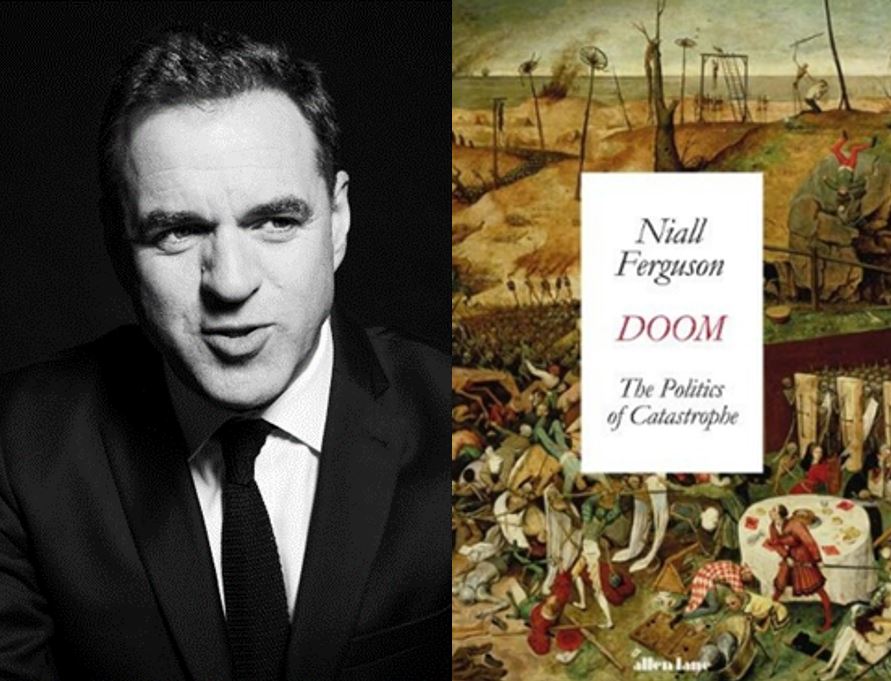
Niall Ferguson is one of the world’s most renowned historians. He is the author of sixteen books, including Civilization, The Great Degeneration, Kissinger, 1923-1968: The Idealist, and The Ascent of Money. He is the Milbank Family Senior Fellow at the Hoover Institution, Stanford University, and the managing director of Greenmantle LLC. His many prizes include the International Emmy for Best Documentary (2009), the Benjamin Franklin Award for Public Service (2010), and the Council on Foreign Relations Arthur Ross Book Award (2016).